
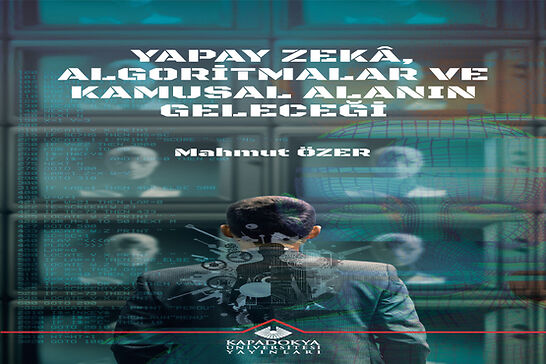




The digital age, accelerating the rhythm of time, has trapped humanity within a network of its own making. Woven from data, this invisible network no longer merely carries information; it writes destinies, draws boundaries, and silently shapes the future of society. Artificial intelligence is giving a new direction to humanity’s age-old dreams; while its possibilities inspire fascination, the limitations it brings with it also generate profound concern. At precisely this threshold, this book opens a window into the truth behind the enchantment. Artificial Intelligence, Algorithms and the Future of the Public Sphere strikingly reveals how data is transformed into power, the invisible influence of algorithms, and how social inequalities deepen throughout this process.
Mahmut Özer demonstrates that algorithms represent far more than innocent calculations. By examining how the relationships among success, reward, and performance are being reconstructed in education, the workforce, politics, and culture, he traces the inequalities that remain hidden from view. He compares the decline of the middle classes to the exhaustion of a society’s immune system and presents, in a striking style, the turbulent developments that await us in the public sphere of the future.
This work takes readers not only into today’s technological debates but also toward humanity’s age-old questions. Cathy O’Neil’s critique of destructive models, Barabási’s laws of success, Erdin’s ranking games, T. Markovitz’s meritocracy trap, Ibn Khaldun’s reflections on fate, and Alev Alatlı’s warning about the possibility that mediocrity may not be deserving of what it receives all come together in an interconnected intellectual landscape. Every page reminds us that technology is not neutral; on the contrary, it creates an order shaped by values.
Therefore, in the face of the rising wave of artificial intelligence, this book is much more than a warning—it is an invitation addressed to the future. In a language that is accessible yet profound, Özer invites readers to question how freedom, justice, and the essence of what it means to be human can be preserved in the shadow of digitalization and artificial intelligence. Within these pages, readers will find not merely an analysis, but also a journey that invites them to rethink their own future.