

Cappadocia University brought together experts and industry representatives through the 2nd National Artificial Intelligence Summit held on October 16–17, 2025.
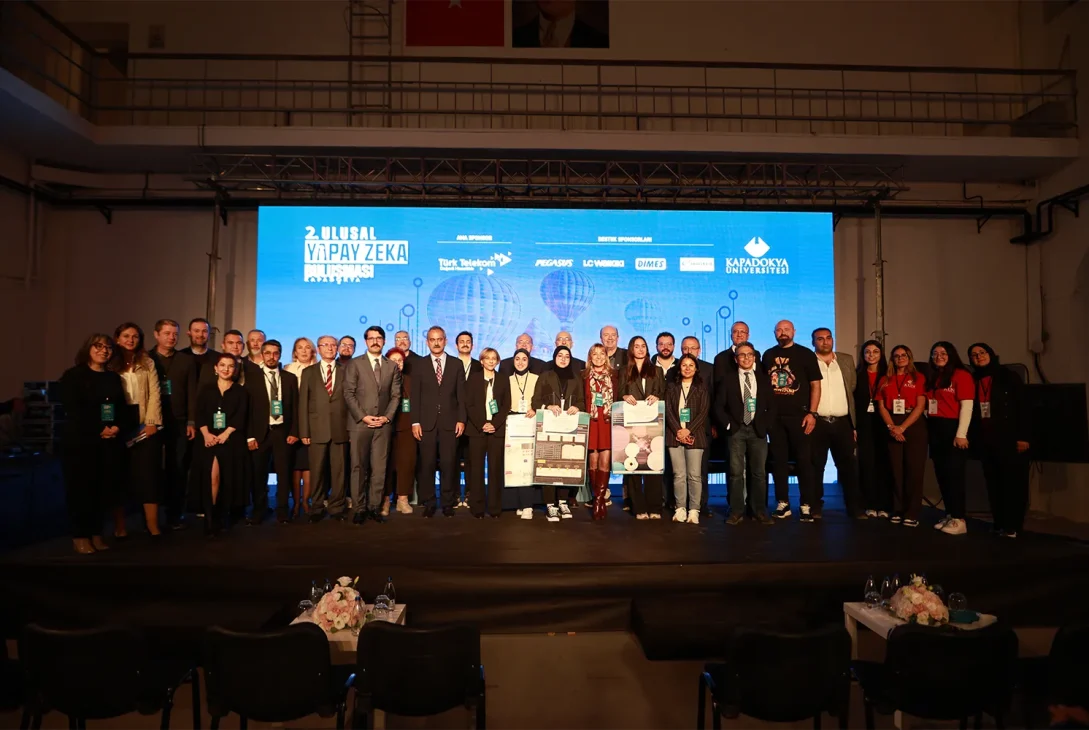
The 2nd National Artificial Intelligence Summit Cappadocia, which brought together experts, academics, entrepreneurs, and industry representatives in the field of artificial intelligence at Cappadocia University (KÜN), was held on October 16–17, 2025, at the KÜN Factory Campus. Organized with Türk Telekom as the main sponsor and supported by Pegasus, LC Waikiki, Dimes, and Commited, the event addressed the multidimensional impacts of artificial intelligence in education, healthcare, defense industry, communication, and the business world.
The summit was attended by former Minister of National Education and 28th Term Member of Parliament for Ordu Prof. Dr. Mahmut Özer; Ürgüp District Governor Ömer Coşkun; Cappadocia University Rector Prof. Dr. Hasan Ali Karasar; Member of the Council of Higher Education (YÖK) Executive Board Prof. Dr. Derviş Karaboğa; Vice Chairman of Eczacıbaşı Holding and Chairman of the Turkish Informatics Foundation Faruk Eczacıbaşı; Chair of the Board of Trustees of Cappadocia University Funda F. Aktan; and Member of the Cappadocia University Advisory Board Barış Karakullukçu.
Ürgüp District Governor Ömer Coşkun:
In his speech, Ürgüp District Governor Ömer Coşkun emphasized that the presence of Cappadocia University in Ürgüp is a great asset for the region. Stating that one of the fundamental responsibilities of public administration is to ensure security and public order, Coşkun noted that without security, no other issue can retain its meaning. Emphasizing that the concept of security must be redefined alongside technological development, he said, “In a world where settlements are expanding and populations are growing, we need to redesign the concept of security through technology and artificial intelligence–supported approaches.” Noting that artificial intelligence is still at an early stage of development, Coşkun concluded his remarks by highlighting the importance of the summit hosted by Cappadocia University.
Cappadocia University Rector Prof. Dr. Hasan Ali Karasar:
“Entering its 20th year, Cappadocia University continues its vision of being a center that produces global solutions rooted in local values, as it always has.”
Recalling the interest of the University’s founder, Alev Alatlı, in high technology and innovative developments, Rector Prof. Dr. Hasan Ali Karasar stated, “In her later years, our founder had a particular interest in artificial intelligence and blockchain. She left these fields to us as strategic development areas of our University.” Referring to Cappadocia University’s four main focus areas, Karasar said, “The foundations of our University are built on aviation, healthcare, tourism, and information technologies. Under this last heading, we have been making significant investments in artificial intelligence, data analytics, and cybersecurity in recent years.” Emphasizing that KÜN is not only an educational institution but also a center for scientific solutions, digital transformation, and ethics-based artificial intelligence studies, Karasar noted that such meetings increase awareness across Türkiye. Reiterating the University’s vision as it enters its 20th year, Karasar recalled its mission with the following words: “To educate a new generation of public opinion leaders and pioneers who will make Türkiye a decisive actor in the 21st century.”
Karasar concluded his speech by stressing that artificial intelligence and data science studies should be evaluated within a sustainable development vision grounded in the principles of reason, ethics, justice, and propriety.
YÖK Executive Board Member Prof. Dr. Derviş Karaboğa:
Stating that significant transformations have taken place in Türkiye’s higher education structure through decisions made by the Council of Higher Education, Prof. Dr. Derviş Karaboğa emphasized that developments in artificial intelligence lie at the core of these changes. “Every country’s most important competitive advantage is its human capital. We must train our young people—our future—in the right, competent, and well-equipped way,” he said.
Noting that there are approximately 200,000 IT specialists in Türkiye and that only 5 percent specialize in artificial intelligence, Karaboğa stated that this ratio is expected to reach 20 percent by 2030. Emphasizing that Türkiye needs to train approximately 5,000 new AI specialists each year, he explained that newly established university programs will meet this need. Karaboğa noted that there are currently 22 active artificial intelligence engineering programs in Türkiye, a number expected to reach 40 in the near future, and that four-year AI and machine learning–focused programs have begun to open in economics, science, and other faculties. Drawing attention to the balance between speed and quality in education, he stated, “To equip students with competencies in a short time, we must build not only human resources but also an AI-supported education and security concept.”
Vice Chairman of Eczacıbaşı Holding and Chairman of the Turkish Informatics Foundation Faruk Eczacıbaşı:
“Cappadocia University occupies a position that brings together history and technology, nature and artificial intelligence. This structure has the potential to train qualified human resources not only for Türkiye but also for the world.”
Referring to the technological transformations of the past 35 years, Faruk Eczacıbaşı stated that developments such as social media, smartphones, cryptocurrencies, and artificial intelligence have radically changed not only technology but also social behavior patterns. He emphasized that artificial intelligence has become not just a tool, but a paradigm that influences social norms and decision-making processes.
Praising Cappadocia University’s interdisciplinary approach, Eczacıbaşı reiterated that the University’s unique position enables it to train qualified human resources on a global scale. Highlighting the importance of maintaining a calm and opportunity-focused approach in the age of artificial intelligence, he concluded by saying, “Everyone in the world is confused, but within this confusion lies great potential. If we manage it correctly, we can reach a much stronger position in the future.”
Cappadocia University Advisory Board Member Barış Karakullukçu:
Introducing the 2nd National Artificial Intelligence Summit Cappadocia, Barış Karakullukçu drew attention to the rapid developments in the field of artificial intelligence over the past year, stating, “We have left behind a year in which we heard news of a new breakthrough or investment almost every week. We can now generate video from text, music from writing, and work alongside our digital assistants.”
Emphasizing that artificial intelligence has become not merely a technology but the infrastructure itself, Karakullukçu stated, “The future of artificial intelligence means the future of humanity. Therefore, we must adopt a human-centered, ethics-based approach.” Noting that AI is also transforming institutional structures, he added, “Organizations are now discussing how to integrate AI agents alongside human employees. This transformation has moved beyond theory and turned into tangible value.” Karakullukçu also noted that important steps are being taken in Türkiye regarding local language models, public strategies, and regulatory efforts in the field of artificial intelligence, and emphasized the need to accelerate this process with the right rules. Congratulating Cappadocia University on its new faculty and initiatives in artificial intelligence, he stated, “The essence of this summit is to bring together technology, industry, academia, and the public sector to discuss concrete data, action plans, and real challenges. Over the next two days, we will delve into the depths of this transformation across eight different sectoral axes.”
The Multidimensional Impact of Artificial Intelligence Discussed
Throughout the summit, panels examined the most current topics in the field of artificial intelligence in depth. Titles such as “Artificial Intelligence and Education: Next-Generation Education and Science,” “Artificial Intelligence and Transformation in the Defense Industry,” “Health 5.0: The Future of Healing with Smart Systems,” “The Evolution of Professions in the Age of Artificial Intelligence,” and “Transformation in Communication” provided participants with critical insights into the role, strategic importance, and future impacts of artificial intelligence across different sectors. The summit offered participants from academia, the business world, and the entrepreneurial ecosystem the opportunity to learn about the latest developments in artificial intelligence and to share experiences.