
3.3.1 – Local, National and Global Health Partnerships
Institutional Partnerships to Advance Health and Well-being at Cappadocia University
1. Our Institutional Approach
At Cappadocia University, we regard the promotion of physical, mental and social well-being as an integral element of our institutional responsibility under United Nations Sustainable Development Goal 3 (SDG 3): Good Health and Well-being.
We do not approach health education and research in isolation from the health needs of the communities we serve. Instead, we bring academic expertise into contact with healthcare practice, promote preventive health interventions, strengthen professional preparation and develop institutional cooperation with organisations operating outside the University.
Our partners include public healthcare bodies affiliated with the Republic of Türkiye Ministry of Health, local hospitals, family health centres, special education and rehabilitation centres, independent providers of dental technology services, the Social Security Institution (SGK) and the Turkish Red Crescent (Türk Kızılay). These organisations are institutionally separate from Cappadocia University.
Our partnership mechanisms comprise formal protocols, healthcare service agreements, clinical placements, vocational and practice-based education, jointly delivered educational events, field research, preventive healthcare activities and volunteering initiatives. Through these complementary arrangements, we seek to develop the quality and accessibility of healthcare, enhance the professional competencies of our students and make evidence-informed health information available to the wider community.
Our work in 2025 demonstrates that collaboration goes well beyond signing agreements. It encompasses structured partnerships supporting practical education, applied research, health service provision, mental well-being and community participation. The sections below present the activities undertaken during the 2025 calendar year and relevant activities in the 2024–2025 period which show the continuity of our engagement with external health stakeholders.
2. Scope of Our Health Partnerships
Table 1. Overview of Local, Regional and National Partnerships in Health
Area of cooperation |
External organisation |
Main institutional activity |
|---|---|---|
Public healthcare services |
Ministry of Health – Kayseri Provincial Directorate of Health |
Clinical placements, vocational training, practical instruction and research coordination |
Local hospital partnership |
Özel Kapadokya Hospital |
Hospital-based practical education, educational coordination committee and professional exchange |
Primary healthcare |
Eight family health centres in Ürgüp and Avanos |
Early childhood oral-health research, parent education and assessment |
Rehabilitation |
Güven Special Education and Rehabilitation Centre |
Practical education in physiotherapy, rehabilitation and speech and language therapy |
Rehabilitation |
Kapadokya Special Education and Rehabilitation Centre |
Practical training, knowledge exchange and research cooperation |
Mental health |
Pendik District Directorate of Health |
Mental resilience education for students |
Mental health |
Provincial Directorate of Health |
Seminar promoting young people's mental health and well-being |
Dental technology |
Prime Dental Dental Prosthetics Laboratory |
Dental prosthetics training and professional knowledge exchange |
Healthcare financing |
Social Security Institution (SGK) |
Healthcare service procurement agreement |
Blood donation and volunteering |
Turkish Red Crescent |
Blood donation campaigns and health awareness activities |
Health-related academic cooperation |
Nevşehir Hacı Bektaş Veli University |
Cooperation towards a joint doctoral programme in Periodontology and Oral Diagnosis |
Detailed explanation of Table 1. Table 1 demonstrates the breadth of our external institutional engagement, covering public and private healthcare, primary care, rehabilitation, mental health, dental technologies and the national healthcare financing system. The different partnerships serve complementary functions: clinical education, research, service provision, health education and community engagement.
Ministry of Health – Kayseri Provincial Directorate of Health. Our protocol creates a formal framework for practical and clinical education within public healthcare facilities. It connects our health-related academic programmes with the healthcare system in which graduates will ultimately practise and establishes mechanisms for coordinating placements and research.
Özel Kapadokya Hospital. The partnership links our health programmes to hospital services and establishes structured arrangements for practical education. These include the planning of training places, the coordination of placements and the assessment of students' practice-based learning.
Eight family health centres in Ürgüp and Avanos. Our early childhood oral-health study takes research and preventive health information into local primary-care settings. Educational leaflets and structured questionnaires allow our academic work to reach parents and healthcare professionals outside the University.
Güven Special Education and Rehabilitation Centre. This collaboration supports practice-based education in physiotherapy and rehabilitation and in speech and language therapy. It provides an institutional framework for professional exposure and the exchange of experience with a specialist provider.
Kapadokya Special Education and Rehabilitation Centre. This separate agreement extends opportunities for practice-based education, professional exchange and related academic work. Partnerships with more than one independent rehabilitation provider diversify our links with practice settings.
Pendik District Directorate of Health. We have worked with this public health body at our Istanbul campus to provide mental resilience education, drawing on the expertise of a qualified psychologist to support students' well-being.
Provincial Directorate of Health. Our Young People's Well-being and Mental Health programme brought external mental-health professionals and students together to address resilience, stress management and social support.
Prime Dental Dental Prosthetics Laboratory. This agreement connects our Dental Prosthetics Technology programme with a specialist technical provider working in the dental health sector, supporting practical training and professional exchange.
Social Security Institution. Our healthcare service procurement agreement establishes an institutional relationship between our health service provision and Türkiye's national social security and healthcare financing arrangements.
Turkish Red Crescent. Repeated blood donation campaigns and student volunteering activities have promoted awareness of the importance of voluntary blood donation and participation in community health initiatives.
Nevşehir Hacı Bektaş Veli University. The cooperation protocol strengthens advanced education and research capacity in oral and dental health. This is an additional health-related academic partnership, distinct from our cooperation with independent providers of healthcare services.
3. LOCAL COLLABORATIONS – Partnerships with Local Health Organisations
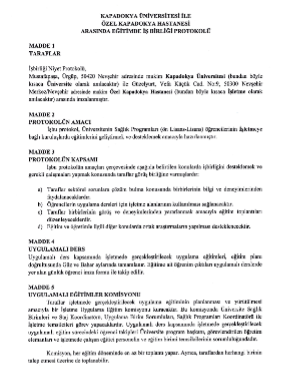
3.1. Practical Health Education in Partnership with Özel Kapadokya Hospital
On 23 April 2025, Cappadocia University and Özel Kapadokya Hospital, an independent hospital operating in Nevşehir, signed an Educational Cooperation Protocol. The principal purpose of the protocol is to develop and support the practical education undertaken by students enrolled on the University's health-related associate degree and undergraduate programmes within the hospital environment.
The partnership is intended to integrate academic study with professional practice in a functioning healthcare setting. It provides for the use of appropriate hospital facilities for practical learning, reciprocal exchange of professional knowledge and experience, educational meetings and the development of opportunities for research associated with education and teaching.
A particularly important element is the Practical Training Committee stipulated by the agreement. The Committee is responsible for coordinating practical training, establishing student capacity, arranging placements and rotations, identifying appropriate educational personnel and evaluating students' performance. The protocol provides for the Committee to meet at least once during each educational term, establishing a recurrent mechanism of cooperation between the parties.
Our relationship with the hospital is therefore more extensive than the placement of individual students. It is a structured institutional arrangement through which responsibilities are assigned, teaching activity is planned and practice-based learning is monitored. In turn, this supports students' familiarity with clinical environments, professional skills and understanding of healthcare service processes.
3.2. Early Childhood Oral Health in Partnership with Family Health Centres
The Faculty of Dentistry at Cappadocia University works with local primary healthcare providers to promote preventive oral-health practices, improve parents' awareness of early childhood dental care and evaluate the contribution of families and healthcare professionals to the prevention of early childhood caries.
Our research project, “Evaluating the Effectiveness of a Family- and Healthcare Worker-Based Preventive Approach to Early Childhood Caries: A Non-Interventional Clinical Study”, began on 20 August 2025 and is scheduled to continue until 20 August 2027. Its field setting consists of eight family health centres in the Ürgüp and Avanos districts of Nevşehir. Its principal target groups are the parents and carers of children aged 0–2 years, alongside healthcare professionals working in these centres.
The study addresses the knowledge, attitudes and behaviours of parents in preventing early childhood caries and assesses the role of frontline healthcare workers in supporting preventive oral health. It connects academic research with everyday primary healthcare encounters, allowing preventive health information and structured assessment to reach families in the community.
Table 2. Eight Participating Family Health Centres
District |
Family health centre |
Role within the collaborative study |
|---|---|---|
Ürgüp |
Ürgüp Family Health Centre |
Parent information and oral-health assessment |
Ürgüp |
Şehit Ömer Halisdemir Family Health Centre |
Distribution of preventive information and field research |
Ürgüp |
Ortahisar Family Health Centre |
Preventive oral-health activities for families |
Ürgüp |
Mustafapaşa Family Health Centre |
Research involving local families and healthcare professionals |
Avanos |
Avanos Family Health Centre |
Parent information and assessment |
Avanos |
Özkonak Family Health Centre |
Oral-health awareness and field research |
Avanos |
Kalaba Hacı Nuri Yaralı Family Health Centre |
Preventive information and assessment activities |
Avanos |
Çalış Family Health Centre |
Primary-care participation in preventive oral-health research |
Total |
8 family health centres |
A collaborative research and information network across two districts |
Detailed explanation of Table 2. Four centres are located in Ürgüp and four in Avanos. The geographical spread is important because it brings our research into several different primary-care settings rather than a single clinic, and allows us to engage with families and healthcare workers in different communities.
Ürgüp Family Health Centre contributes a primary-care setting for communication with local parents and for the delivery of information and assessment related to early childhood oral health.
Şehit Ömer Halisdemir Family Health Centre forms part of the distribution and research network through which our preventive oral-health information is made available to families.
Ortahisar Family Health Centre participates in the study's work on preventive oral-health behaviour, including the everyday practices of parents and carers of very young children.
Mustafapaşa Family Health Centre serves the community in the same settlement as one of our University campuses. Its inclusion creates a direct connection between our academic work and the community immediately surrounding the University.
Avanos Family Health Centre extends the scope of our work beyond Ürgüp and supports engagement with parents and healthcare professionals in another district.
Özkonak Family Health Centre is part of the network through which oral-health information and structured parent assessment are undertaken in local communities.
Kalaba Hacı Nuri Yaralı Family Health Centre contributes a separate primary-care setting for research concerning preventive approaches to early childhood oral health.
Çalış Family Health Centre completes the study's Avanos-based network and broadens opportunities to examine parental oral-care knowledge and behaviour in the community.
Together, these eight centres demonstrate a tangible partnership between university researchers and local healthcare settings. The approach links preventive health education, research methods and the routine contact that families have with primary-care professionals.
3.2.1. Fieldwork and Parent Participation
As part of the study, we distributed oral and dental health information leaflets and assessment questionnaires to all eight participating family health centres. The materials address everyday oral-care practices, the consumption of sugary food and drinks, dental examinations, identification of early signs of tooth decay and the importance of parental supervision.
Questionnaires have been administered to 100 parents within the study. These structured assessments consider parents' knowledge, attitudes and practices concerning their children's oral health, including cleaning routines, dietary habits, preventive dental visits and awareness of early childhood caries.
In addition to parent-facing work, the research addresses the knowledge and practices of nurses and other healthcare professionals working in family health centres. Bringing these groups together helps ensure that early childhood oral health is approached through coordinated preventive action rather than solely through treatment after disease has occurred.
Our work thus combines an educational intervention, community-facing fieldwork and structured research tools in a single project involving both academic and healthcare partners.
3.2.2. Preventive Oral-Health Education Materials
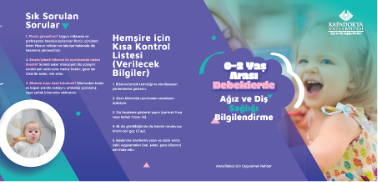
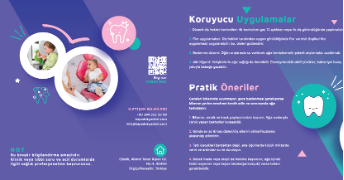
For this initiative, we produced a detailed educational leaflet for parents and carers of children aged 0–2 years. It translates specialist knowledge about oral health into clear information and practical advice applicable to daily family routines.
Topics include the appropriate time to begin mouth and gum cleaning, toothbrushing, a suitable diet, reducing sugary food and drinks, the use of fluoride toothpaste, care of bottles and dummies, teething and the risk factors for early childhood caries. The material also includes a brief checklist for nurses, enabling healthcare professionals to reinforce preventive messages in primary-care settings.
These materials constitute a visible output of the collaboration: academic knowledge is converted into a form that parents and frontline health workers can use in health promotion.
3.2.3. Structured Research and Evaluation Instruments
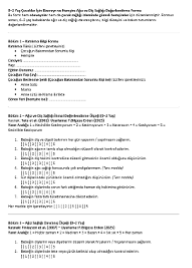
Our study also uses the “Parent and Nurse Oral and Dental Health Assessment Form for Children Aged 0–2 Years”. The form is designed to assess the knowledge and behaviour of both parents and nurses, bringing consistency to the collection of information relevant to preventive oral health.
Its sections cover participant characteristics, oral-care practices, knowledge questions and additional items specifically for nursing staff. The questions address daily cleaning of children's teeth and gums, recognition of possible decay, dental appointments, eating habits and the role of parents in maintaining oral hygiene.
This approach is important because it places structured assessment alongside the provision of educational materials. It enables our community-oriented research to examine relevant behaviours as part of a systematic scientific process.
3.3. Partnership with Güven Special Education and Rehabilitation Centre
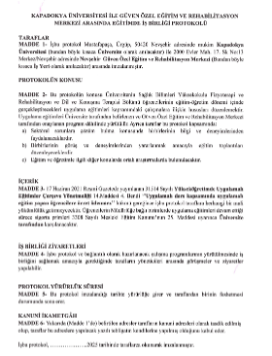
In 2025, Cappadocia University signed an Educational Cooperation Protocol with Güven Special Education and Rehabilitation Centre. The agreement provides a framework for practice-based education for students studying Physiotherapy and Rehabilitation and Speech and Language Therapy.
The protocol covers opportunities for students to engage with a professional rehabilitation setting, institutional exchange of knowledge and experience, educational meetings and support for research linked to teaching and learning. Through this relationship we seek to connect the theoretical education delivered at the University with specialist practice and the needs of individuals receiving rehabilitation support.
Physiotherapy and rehabilitation support physical functioning, mobility and quality of life. Speech and language therapy addresses communication, speech, language and related functions. Preparing students in these fields through contact with professional practice is therefore an important aspect of their development as future practitioners.
Our formal relationship with the Centre establishes a continuing framework through which such collaboration can be planned and developed.
3.4. Partnership with Kapadokya Special Education and Rehabilitation Centre
On 25 September 2025, Cappadocia University signed a further Educational Cooperation Protocol with Kapadokya Special Education and Rehabilitation Centre. This agreement also concerns the practical education of students studying Physiotherapy and Rehabilitation and Speech and Language Therapy.
Our objectives include linking academic teaching with the Centre's professional environment, exchanging specialist experience, organising education-related meetings and developing opportunities for research relevant to professional education. By establishing partnerships with separate rehabilitation providers, we widen the external practice settings with which our health-related academic programmes can cooperate.
These arrangements form part of our institutional approach to strengthening professional preparation through collaboration with organisations independent of the University.
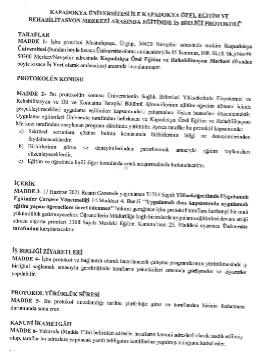
3.5. Mental Resilience Education with Pendik District Directorate of Health
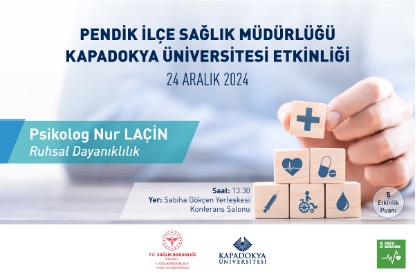
On 24 December 2024, Cappadocia University organised a Mental Resilience educational event in cooperation with Pendik District Directorate of Health, a public health organisation affiliated with the Ministry of Health. The session took place at the conference hall of our Istanbul Sabiha Gökçen Campus and was delivered by psychologist Nur Laçin.
The event was designed to enhance students' awareness of mental resilience, promote the importance of protecting mental health and introduce ways of responding constructively to psychological difficulties. Thirty-three students attended.
This activity demonstrates our direct engagement with an external public health organisation in support of student well-being. It also shows that our health collaboration is not confined to our campuses in Nevşehir: the same institutional commitment extends to our Istanbul campus, where local healthcare expertise can be brought directly into the student learning environment.
The jointly branded publicity material clearly identifies the two organisations, the specialist speaker and the purpose and location of the event.
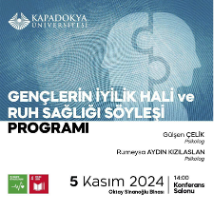
3.6. Young People's Well-being and Mental Health Programme with the Provincial Directorate of Health
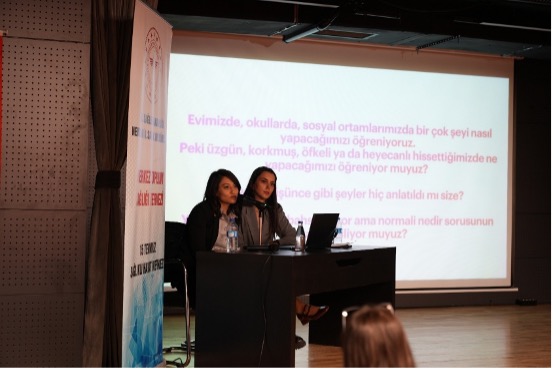
On 5 November 2024, our Guidance and Psychological Counselling Unit organised the “Young People's Well-being and Mental Health” discussion programme in cooperation with the Provincial Directorate of Health. The programme brought psychologists Gülşen Çelik and Rumeysa Aydın Kızılaslan together with our students.
The speakers addressed psychological resilience, a positive self-image, coping with stress and the role of social support. A total of 153 students attended. The event helped bring professional mental-health knowledge into the University and increased awareness of preventive and supportive approaches to psychological well-being.
Taken together, this programme and the Pendik Mental Resilience session show two concrete forms of institutional cooperation with public health organisations. They were delivered on different dates and at different campuses, enabling students to engage with qualified health professionals on complementary dimensions of mental health.
Table 3. Mental Health Education Delivered with Public Health Organisations
Date |
Event |
External health partner |
Venue |
Attendance |
|---|---|---|---|---|
5 November 2024 |
Young People's Well-being and Mental Health |
Provincial Directorate of Health |
Mustafapaşa Campus |
153 |
24 December 2024 |
Mental Resilience |
Pendik District Directorate of Health |
Istanbul Sabiha Gökçen Campus |
33 |
Total |
Two educational events |
Public health organisations |
Two campuses |
186 event attendances |
Detailed explanation of Table 3. The table distinguishes two individual activities and identifies the specific health partners, educational settings and attendance figures, rather than treating them as an undifferentiated total.
5 November 2024 – Young People's Well-being and Mental Health. This programme involved 153 students and addressed psychological resilience, positive self-image, managing stress and the value of social support. The contribution of external psychologists through cooperation with the Provincial Directorate of Health connected our preventive mental-health education with professional health expertise.
24 December 2024 – Mental Resilience. At the Istanbul Sabiha Gökçen Campus, 33 students took part in a session led by psychologist Nur Laçin in cooperation with Pendik District Directorate of Health. The programme focused specifically on mental resilience and illustrates our ability to work with a local public healthcare body to support students at another campus.
The total of 186 is the combined number of event attendances at these two sessions. It demonstrates the reach of the two educational activities, not a claim that 186 different individuals received clinical treatment. The two examples document the participation of external public health bodies in our institution's preventive mental well-being education.
4. NATIONAL COLLABORATIONS – Partnerships with National Health Organisations
4.1. Ministry of Health: Clinical Education and Research Cooperation through Kayseri Provincial Directorate of Health
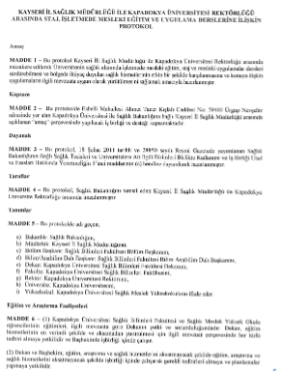
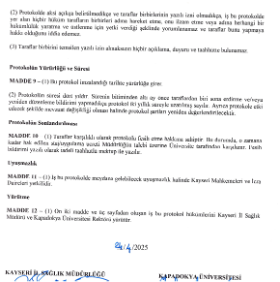
On 24 April 2025, Cappadocia University and Kayseri Provincial Directorate of Health, representing the Ministry of Health, signed a Protocol on Internships, Vocational Education in the Workplace and Practical Courses.
The purpose of this protocol is to establish the arrangements under which students studying health-related subjects at our University can undertake internships, professional training and practical courses in relevant public healthcare facilities. It connects our teaching programmes with the professional environments of the national public healthcare system.
The protocol sets out arrangements for the planning of practice-based education, the identification of student placement periods and capacities, the designation of responsible personnel and coordination between academic departments and healthcare facilities. It also addresses arrangements for clinical research involving University teaching staff, including ethical approval and institutional coordination.
Our cooperation seeks to achieve several mutually reinforcing objectives:
- Clinical education: to support professional learning in public healthcare settings.
- Educational planning: to align student placements with the operational capacity and requirements of health facilities.
- Institutional coordination: to establish clear communication and responsibilities for students, academic staff and healthcare personnel.
- Research cooperation: to provide an institutional framework for coordination on clinical research and relevant ethical procedures.
- Professional preparation: to strengthen the practical competencies of students preparing to work within the health system.
The protocol provides for an initial term of four years and specifies the conditions under which it may be renewed. This is important evidence of the continuing nature of the cooperation: the arrangement is designed to operate across successive academic years rather than as a single visit or event.
By working with the Ministry of Health's provincial healthcare administration, we strengthen the relationship between our programmes and the national healthcare system responsible for delivering health services across Türkiye.
4.2. Social Security Institution: Supporting Access to Healthcare through National Financing Arrangements
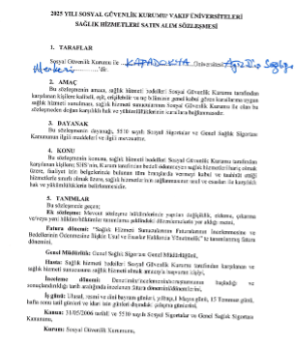
Cappadocia University entered into a 2025 Healthcare Service Procurement Agreement with the Social Security Institution (Sosyal Güvenlik Kurumu, SGK). The SGK operates nationally and has a central role in the application of Türkiye's general health insurance system.
The agreement relates to healthcare services provided in connection with our Oral and Dental Health Application and Research Centre and sets out the procedures and obligations for service provision and payment within the relevant national legal and social security framework.
We recognise that the accessibility of healthcare depends not only on the existence of facilities and skilled professionals but also on the arrangements through which patients can receive and finance appropriate care. The institutional link between our health services and the national social security system is therefore a significant dimension of our approach to access to healthcare.
The contractual framework addresses the relevant requirements for providing healthcare, documenting and reporting services, submitting claims, protecting patients' rights and meeting the obligations placed on the healthcare provider. It thereby connects our institutional health service capacity with the country's national healthcare financing arrangements.
4.3. Turkish Red Crescent: Blood Donation and Community Health Engagement
Cappadocia University has undertaken recurring blood donation and awareness-raising activities with the Turkish Red Crescent (Türk Kızılay) and through student involvement in the Young Red Crescent community. The Turkish Red Crescent operates throughout Türkiye and represents an important external institution in blood donation and humanitarian engagement.
Our activities encourage voluntary blood donation, raise awareness of its value to the health system and create opportunities for students to participate in community-oriented health and volunteering activities. Events held at different points in the 2024–2025 period demonstrate the recurrent nature of our institutional engagement in this area.
Table 4. Turkish Red Crescent and Young Red Crescent Activities
Date |
Activity |
Purpose and implementation |
Location |
|---|---|---|---|
4 November 2024 |
Red Crescent Week Awareness Stand |
Awareness of Red Crescent activities and volunteering |
Ürgüp Fabrika Campus |
7 November 2024 |
Young Red Crescent Nursery School Visit |
Community engagement and awareness activities with children |
Ürgüp Halil Ertuğrul Nursery School |
11 November 2024 |
Red Crescent Blood Donation Campaign |
Encouraging voluntary blood donation |
Ürgüp Health Campus |
20 November 2024 |
Red Crescent Blood Donation Campaign |
Continued campus-based blood donation activity |
Ürgüp Health Campus |
6–7 May 2025 |
Blood Donation with Young Red Crescent |
Donation awareness and volunteering |
Ürgüp Health Campus |
Detailed explanation of Table 4. The table shows a sequence of distinct initiatives rather than a single campaign. Each served a particular aspect of volunteering, public engagement or blood donation.
4 November 2024 – Red Crescent Week Awareness Stand. Our Young Red Crescent student community organised an awareness stand at Ürgüp Fabrika Campus. Forty-seven students took part. The event introduced students to the activities of the Red Crescent and encouraged awareness of volunteering as a form of civic and social engagement.
7 November 2024 – Young Red Crescent Nursery School Visit. Our Young Red Crescent students visited Ürgüp Halil Ertuğrul Nursery School. Twenty-four University students participated in community-oriented educational and awareness activities with children. The visit illustrates how student volunteering can extend beyond University campuses into the surrounding community.
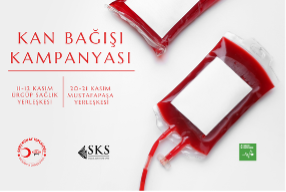
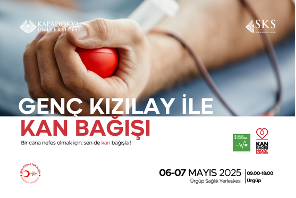
11 November 2024 – Blood Donation Campaign. We held a blood donation campaign at Ürgüp Health Campus to promote voluntary donation and the community's understanding of its importance. Hosting this activity within our health campus connected student and staff awareness with a practical public-health contribution.
20 November 2024 – Blood Donation Campaign. A further campaign was included in the University's activity programme at Ürgüp Health Campus. The repeated activity reinforces that blood donation featured on more than one date during the academic term, and was not treated solely as an isolated publicity event.
6–7 May 2025 – Blood Donation with Young Red Crescent. We continued blood donation awareness and volunteering activities at Ürgüp Health Campus in May 2025. Organised with the involvement of Young Red Crescent, the activity encouraged students to engage with the social value of voluntary donation. In the context of the November campaigns, it demonstrates continued engagement across different periods of the academic year.
Taken together, these activities demonstrate a recurring programme of health-related volunteering, public awareness and student participation associated with the national Turkish Red Crescent network.
5. Complementary Academic Partnerships and Community Well-being Activities
5.1. Cooperation with Prime Dental Dental Prosthetics Laboratory
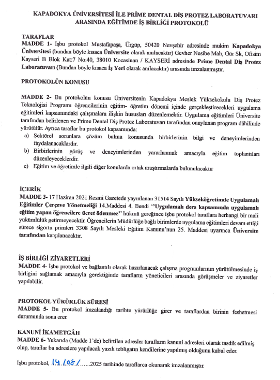
On 14 August 2025, Cappadocia University signed an Educational Cooperation Protocol with Prime Dental Dental Prosthetics Laboratory, an independent organisation operating in Kayseri. The protocol concerns students enrolled on the Dental Prosthetics Technology Programme at Cappadocia Vocational School.
The agreement is designed to support practical vocational education through cooperation with a provider involved in the technical aspects of dental healthcare. It covers practical education, the exchange of knowledge and professional experience, educational meetings and opportunities for research associated with teaching.
Dental prosthetics technology provides essential technical support for clinical oral and dental healthcare. Cooperation with a specialist laboratory therefore links the professional preparation of our students to the practical processes and technologies used in this part of the health sector.
5.2. Academic Cooperation in Dentistry with Nevşehir Hacı Bektaş Veli University
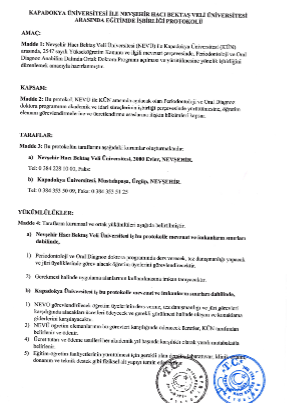
On 30 July 2025, Cappadocia University and Nevşehir Hacı Bektaş Veli University signed an Educational Cooperation Protocol concerning the establishment and delivery of a joint doctoral programme in Periodontology and Oral Diagnosis.
The protocol provides for institutional coordination in advanced dental education and research, including the assignment of academic staff, teaching, thesis supervision, examination committees, use of academic facilities and support for shared scientific activity. It also addresses research and development projects, conferences, seminars and other academic initiatives.
This is a complementary collaboration in health-related academic education and research, rather than an agreement with an independent healthcare service provider. It nevertheless strengthens our institutional capacity to develop advanced expertise and research in oral and dental health alongside the partnerships with healthcare organisations documented above.
5.3. Oral and Dental Health Week: Community Awareness Activities
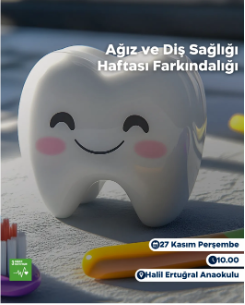
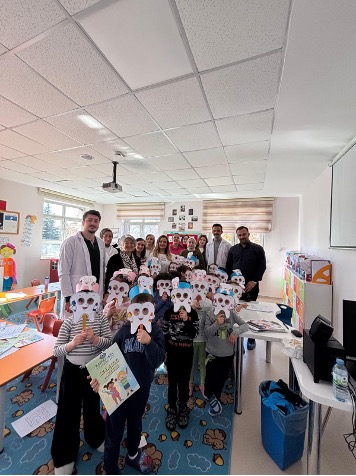
On 27 November 2025, the Oral and Dental Health Programme at Cappadocia Vocational School organised an awareness initiative for Oral and Dental Health Week. Activities took place at Halil Ertuğral Nursery School and at University campus locations.
During the nursery school visit, our students and dentist academic staff introduced children to the importance of oral health, effective toothbrushing and basic ways of protecting their teeth. They used colouring materials, visual resources, interactive games and age-appropriate methods to make the information accessible and engaging.
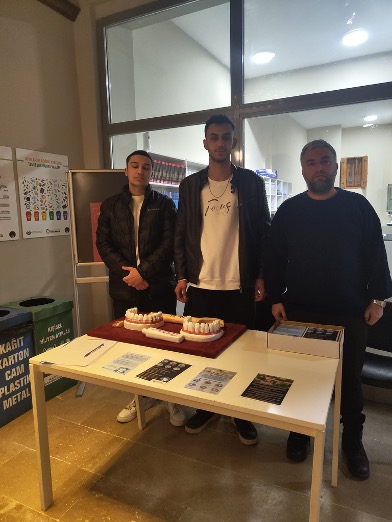
At the University, students established information stands to promote preventive oral-health practices among fellow students and staff. Educational leaflets and models supported discussions of everyday oral hygiene and the prevention of oral-health problems.
Fourteen students from our Oral and Dental Health Programme participated in the nursery school activity, while 31 participated in the University-based activity: 45 student participants in total. Through this work, our students shared professional knowledge with the community while gaining experience in health education and social responsibility.
The activity demonstrates how our training programmes translate health education into community engagement and promote oral-health awareness among different age groups.
5.4. Social Participation and Psychosocial Well-being among Older People
Our understanding of health and well-being includes social participation, psychological support and the needs of people at different stages of life. Student communities therefore undertake community activities which complement our clinical and preventive health partnerships.
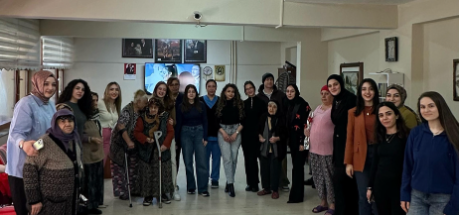
On 13 November 2024, 20 students from our Pusula Psychology student community visited Hacıbektaş Rıfat Kartal Residential Care Home and took part in activities promoting intergenerational interaction.
On 16 January 2025, a student community from our Istanbul campus visited KASEV Residential Care Home, with 18 University students participating.
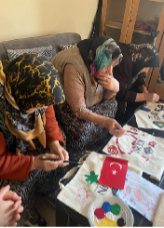
On 8 March 2025, our Community Volunteers student community organised a bag-painting workshop with women at Hacıbektaş Rıfat Kartal Residential Care Home. Fifteen University students participated in this activity, which promoted shared creative activity and social interaction.
These activities are presented as complementary evidence of our commitment to social and psychosocial well-being. They are not presented as clinical treatments or substitutes for our partnerships with healthcare organisations.
Table 5. Community Activities Supporting Older People's Social Well-being
Date |
Activity |
External organisation |
University students participating |
|---|---|---|---|
13 November 2024 |
Residential care home visit |
Hacıbektaş Rıfat Kartal Residential Care Home |
20 |
16 January 2025 |
Residential care home visit |
KASEV Residential Care Home |
18 |
8 March 2025 |
Bag-painting workshop with women |
Hacıbektaş Rıfat Kartal Residential Care Home |
15 |
Detailed explanation of Table 5. Each activity involved a separate occasion of student participation in a community setting. Together they illustrate how the University approaches social well-being across generations.
13 November 2024 – Hacıbektaş Rıfat Kartal Residential Care Home visit. Twenty students from our Pusula Psychology community engaged with older residents in a social setting. The visit supported interpersonal contact and helped students develop sensitivity towards the social and emotional needs of older people.
16 January 2025 – KASEV Residential Care Home visit. Eighteen students from our Istanbul campus took part in a visit to KASEV, extending student-led activities concerned with older people's social well-being to another city in which the University operates.
8 March 2025 – Bag-painting workshop. Fifteen students joined women at Hacıbektaş Rıfat Kartal Residential Care Home in a creative workshop for International Women's Day. The shared activity encouraged interaction, participation and intergenerational solidarity in a supportive setting.
Across the three activities, there were 53 student participations. They demonstrate the social contribution made by our student communities alongside, but distinct from, the clinical, research and healthcare partnerships presented elsewhere on this page.
6. GLOBAL COLLABORATIONS – International and Global Health Engagement
Cappadocia University approaches health education, research and community engagement with an openness to international cooperation and the exchange of professional knowledge. The relationships documented on this page establish a foundation for further academic and healthcare collaboration across institutions and regions.
The specific documentary evidence presented for the 2025 reporting year concerns local and national health partnerships. We therefore distinguish these evidenced forms of cooperation from prospective international or global relationships rather than treating international ambition as evidence of an existing global healthcare partnership.
7. Institutional Contribution to Health and Well-being
The activities described above demonstrate that our approach to partnerships is multidimensional and sustained. Education, research, preventive care, mental well-being, access to services and voluntary community engagement reinforce one another.
7.1. Strengthening Education for Healthcare Professions
Our cooperation with the Ministry of Health, hospitals, rehabilitation providers and dental technology specialists establishes formal connections between academic study and healthcare practice. These agreements set out responsibilities for organising practical learning, educational coordination and professional knowledge exchange, helping students prepare for the demands of healthcare environments.
7.2. Advancing Preventive Healthcare
The early childhood oral-health study across eight family health centres is a direct example of academic research operating through primary-care settings. The educational leaflets, assessment forms and 100 parent questionnaires connect preventive information with structured evaluation of practices relevant to children's oral health. The project brings together University researchers, healthcare professionals and families to address prevention at an early stage of life.
7.3. Supporting Mental Health and Psychosocial Well-being
Our work with the Provincial Directorate of Health and Pendik District Directorate of Health has brought professional expertise into student education on resilience, stress and social support. The two specifically documented activities involved 186 event attendances, delivered at different campuses and addressing complementary aspects of mental well-being.
7.4. Supporting Access to Healthcare
Our 2025 agreement with the Social Security Institution connects healthcare provided by the University with the national arrangements governing the financing of eligible services. This contractual cooperation is an important institutional mechanism in the relationship between healthcare provision and access.
7.5. Encouraging Volunteering and Community Participation
Blood donation campaigns associated with the Turkish Red Crescent promote awareness of the contribution that voluntary donation makes to the health system. Our community programmes involving older people also encourage students to contribute to social participation and psychosocial well-being. Together, these initiatives broaden the ways in which the University engages with health beyond the classroom and clinic.
8. Conclusion
During 2025, Cappadocia University strengthened its institutional approach to health and well-being through cooperation with independent public healthcare bodies, hospitals, family health centres, rehabilitation providers, professional dental services, national institutions and community organisations.
The Ministry of Health protocols, the hospital and rehabilitation agreements, the eight-centre preventive oral-health study, mental-health education delivered with public health authorities, the SGK healthcare agreement and recurrent Turkish Red Crescent blood donation activities provide distinct forms of evidence of cooperation with organisations operating outside our University.
These relationships share a common purpose: connecting university teaching and research with professional health expertise, public healthcare systems and community needs. By strengthening practical education, supporting preventive oral-health knowledge, promoting mental well-being, facilitating health service provision and encouraging volunteering, our partnerships contribute to the aims of SDG 3 – Good Health and Well-being.
Cappadocia University remains committed to developing these evidence-based institutional partnerships and to making the benefits of academic knowledge, professional cooperation and preventive health education accessible to the communities we serve.
Taken together, these institutional partnerships contribute directly to SDG 3 (Good Health and Well-being) by promoting preventive healthcare, mental health awareness, access to health services and community-based health initiatives; SDG 4 (Quality Education) by strengthening clinical training, practical learning opportunities and professional competencies in health-related disciplines; and SDG 17 (Partnerships for the Goals) by fostering sustained cooperation between the University and independent public healthcare institutions, private healthcare providers and civil society organisations. Furthermore, our activities supporting older people's social well-being and promoting access to healthcare align with the inclusive objectives of SDG 10 (Reduced Inequalities). Through these interconnected contributions, Cappadocia University demonstrates how institutional health partnerships can advance multiple Sustainable Development Goals while strengthening the University's broader commitment to sustainable development.